Q&A With Jennifer Murphy
I recently finished reading Jennifer Murphy’s new release The Ghost Women, & I’m so excited about doing this Q&A with Jennifer! Jennifer’s other novels are also Scarlet In Blue & I Love You More.
Q: Welcome to Book Notions Jennifer! Would you please give a brief description of your books beginning with your recent release The Ghost Women?
A: Thank you, Bianca!
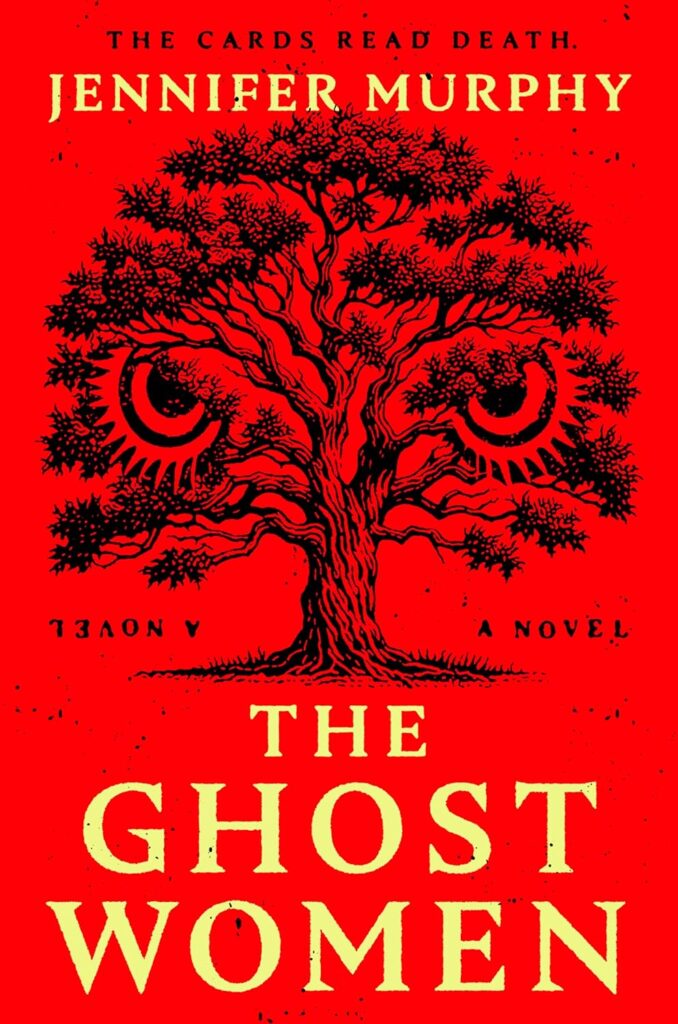
The Ghost Women. A mysterious art academy in the woods, a deck of ancient tarot cards, a centuries-old secret. On a hot August morning in 1972, the body of Abel Montague, a student at St. Luke’s Institute of the Arts, is found hanging from a tree in the forest. An ancient Hanged Man tarot card is found in the back pocket of his pants, and his body has been positioned into the exact pose illustrated on the card. When Detective Lola Germany arrives at St. Luke’s—a former monastery that once housed a secret order of monks who carried out witch trials and executions—she believes they are dealing with a ritualistic murder. While interviewing school administrators and Abel’s classmates, Lola discovers Abel’s live-in girlfriend, Pearl, seems shaken but also might be hiding something—along with her group of friends who call themselves witches. When more students are found dead, each body arranged like a tarot card, Lola realizes she is trapped in a web of power and ambition that spans centuries. Soon, the lines between past and present, spiritual and tangible, begin to blur, and the only way to survive is to seek answers from places she never imagined.
Scarlet in Blue. For Blue Lake’s entire life, she and her mother, Scarlet, have been on the run from HIM – the man who Scarlet, a talented and enigmatic painter, insists is chasing them. But now, at fifteen years old, Blue has begun to resent the nomadic life that once seemed like an adventure. Increasingly unsure what to make of the phantom pursuer she’s never seen, she yearns to settle down in one place, to live a normal life. It seems that Blue’s wishes might finally become true when Scarlet and Blue arrive in the beachfront town of South Haven, Michigan. She makes friends, is falling in love for the first time, and has found a piano teacher who recognizes her budding talent. But even as Blue thrives, she cannot shake her worry about her mother, who seems to be creating paintings that are increasingly difficult to understand. Scarlet, meanwhile, has very different intentions for their stay in South Haven. It was no accident that she brought them there, and, with the help of the psychoanalyst she’s sought out – Henry – she is determined to find a way to finally escape the shadow of her traumatic past, no matter the cost.
I Love You More. A novel of betrayal, jealousy and revenge, it is the story of a man who has three wives who discover one another and plot his perfect murder. Picasso Lane is eleven years old when her father, Oliver, is shot at their summer beach house. Her mother, Diana, is the primary suspect – until the police discover his second wife, and then his third. The women say they have never met, but Picasso knows otherwise. She remembers the morning beautiful Jewels showed up at their house carrying the same purse as her mother’s and a family portrait featuring her father with two strange boys. Picasso recalls spying her mother climbing into a car with Bert, a woman heavily pregnant with Oliver’s fourth child. As the police circle and a detective named Kyle Kennedy becomes a regular fixture in their home, Picasso tries to make sense of her father’s death, the depth of his duplicity, and the secrets that bind these women together.
Q: Where did the idea for The Ghost Women come from? How long did it take you to write it?
A: It began with tarot and the idea that the murders would be based on, and the victim’s bodies positioned like the pictures on tarot cards. For years, a memory had been floating through my mind, and I knew one day I’d write a novel about tarot. It needed time to cook. I was nine years old the first time I saw a deck of tarot cards. One of my babysitters brought them to our house. She waited until my parents left before whispering to me, “Would you like me to tell your future? These cards contain magic.” She added, “Don’t tell your parents.” This of course made whatever it was she was about to do even more intriguing. Those cards stayed with me. I was enamored by how beautiful they were. Over the years I collected tarot cards, but I was never able to find ones as ornate and beautiful as my babysitter’s deck. Years later while walking through the San Lorenzo Market in Florence, Italy, I came upon a merchant whose wares included homemade candles, incense, and several decks of tarot cards, and I saw a deck that resembled my babysitter’s: oversized and sparkly with gold leaf. The merchant said the deck was a facsimile of one used by the 15th century Italian aristocracy, but that back then the cards weren’t used for fortune telling. They used to play a game called Tarocchi, and it was a few centuries before tarot was used for fortune telling. That was the spark, I believe. So, as I was researching the history of tarot, The Ghost Women began to formulate in my mind. I imagined murders at an art school. I wanted to somehow combine my two master’s degrees, the first in painting. The second in writing. I imagined a court artist whose teacher stole the creation of his cards and had the court artist sent to a faraway island so no one would find out he wasn’t the real artist. I imagined he arrived at a monastery where witch burnings were occurring, and the story went from there. It took me about a year to research and write the first draft, but the editing process took another year and a half or so.
Q: Which scenes were your favorite to create in The Ghost Women? It’s hard to choose to be honest. I did like when Lola went to see Madam Luna & I did enjoy how the history of centuries before connected with the 1970s and of course the reveal at the end!
A: For Lola, one of my favorite scenes is when she walks through the Garden of Angels the first time (pages 38-41), and then when she heads to her tree and hears the sound that is wrong for the forest. I like all the scenes in the forest, their darkness, their eeriness. My goal was to make the forest feel dark and scary. I wanted the entire novel to have a magical yet deeply ritualistic feel, in the same way that tarot itself does. For Pearl, my favorite scene is her remembering the drawing class the first time she met Abel (pages 21-24). Perhaps I like this scene because it is based on reality. Something very similar happened to me during my first drawing class at undergraduate school. That troupe of deviant dancers really happened. During edits, my editor had me tame down the way they were (or actually weren’t) dressed. In actuality, the dancers’ costumes were much skimpier and erotic.
Q: What lessons & reminders do you hope readers come away with once they turn the final page?
A: I hope that we as women both understand how far we’ve come, and perhaps how far we haven’t. It still makes me so sad and angry to think about those early days when women were accused of witchery just because they weren’t married or their husbands wanted new wives or they didn’t stay within their lane, so to say. When doing research for this book, I was stunned by the sheer number of burnings and stonings that took place, and the role that the Catholic Church played in them. I was raised catholic and went to parochial school, so I think it was even harder for me to come to terms with this dark history. I think also I wanted to create the ghost women and the ghost tree as a way to hang onto hope for a better future. I loved the idea of the ghost women living inside a beautiful tree in a deep, dark forest. As if after death the tree brought light to their dark histories, and I evenly secretly hoped that readers might take away a sense that a magical tree might help the struggles women face today, as it seems that some of the ground we might have gained may be reversing.
Q: If/When The Ghost Women become a movie or a series, who would be your dream cast to play the characters you created? A suggestion for Lola would be Megan Fahy from the tv show, The White Lotus?
A: Oh, Megan Fahy is a great choice! I actually did a “dreamcasting” for either a tv miniseries or a movie for Marshal Zeringue on Facebook. I had the most difficulty choosing Lola as there were a few actresses I thought might capture her combination of strength and vulnerability. This was my list of potential actors.
Lola Germany (Waverly Island’s lead detective, previously danced for the New York City Ballet): Elizabeth Moss ( I was searching for actresses that actually began as ballet dancers.)
The Weird Sisters (a group of students that engage in witchery)
Pearl Calhoun – Emma Laird
Karla Gardyn – Anya Taylor-Joy
Esme Li – Lana Candor
Hazel Donovan – Sadie Sink
Abel Montague (the first victim, but present through flashbacks) – Harris Dickenson
Colin (Lola’s sidekick) – George MacKay
Alice Landry (the art academy dean) – Ana de Armas
Monty Montague (Abel’s father and the school founder) – Cillian Murphy
Q: If The Ghost Women were to get a sequel, what would Lola, Pearl, and the other characters that are still alive be doing right now?
A: To my mind, Lola would still be a detective on Waverly Island. She’d be much more seasoned, of course. I see Pearl and Lola as having successfully pursued painting careers. Pearl would be very famous by now. I imagine she and Lola would have stayed in touch, and the paintings of Lola would be Pearl’s most famous and iconic. I see Hazel transitioning her career to theater. She is creating screenplays instead of canvases based on her foray into theatric presentations. I imagine Karla maintaining a second home on Waverly Island, perhaps even the same cabin where she lives in The Ghost Women. She holds a ritual every year on the Autumn Solstice at the ghost tree where she remembers her Aunt Matilda. She of course invites the Weird Sisters, Lola, and Priscilla. I’ve toyed with the idea of writing a novel about one of these reunions. It’s still formulating in my mind, but of course a murder (or a few) could occur during one of these reunions.
Q: If you are currently writing your next novel, will it be similar to The Ghost Women, or Scarlet In Blue & I Love You More? Or is this next novel something totally different and unexpected?
A: I am currently writing a new novel. It is the story of a series of murders that are happening in the great Hiawatha State Park of Michigan’s Upper Peninsula, a setting that includes miles and miles of deep, dense forest land. The main protagonist is a sixteen-year-old girl in desperate need of a heart transplant. She has been waiting since she was a child to find a match. When the perfect match is finally found, she begins to have visions and feelings that belong to the donor who was murdered. So she sets about trying to solve her donor’s murder by seeing and feeling the murderer through the heart she now carries. I’ve done a lot of research into transplant patients who swear they feel and sometimes take on some of the attributes of their donors, which fascinates me. And thus, so does my protagonist. Along the way she will also discover that several young women and girls have died in the forest, all with their hearts cut out. It will be magical and spiritual like The Ghost Women. And it will have that deep, dark, scariness like the forest in TGW. But the heroine, Agatha Gray, will be much more attitudinal, spunky and brave than Pearl. More like Picasso Lane in I Love You More and Blue Lake in Scarlet in Blue.