Newsletters
Q&A With Dr. Zaldy Tan
New Information about Upcoming Book Related News

Q&A With Dr. Zaldy Tan
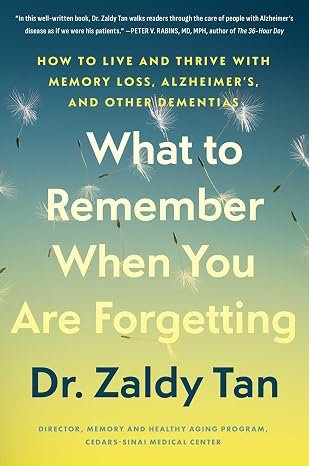
Renowned memory and Alzheimer’s disease specialist, researcher, educator and author Dr. Zaldy Tan wrote & had his book published on September 15th, What To Remember When You Are Forgetting. I now have the honor of interviewing Dr. Tan as we dive deep into the book and the research it took to write it! If you would like to buy the book here is the link https://www.simonandschuster.
Q: Welcome to Book Notions Dr. Tan! It’s an honor to be interviewing you! What made now, the right time to research and write the book What To Remember When You Are Forgetting?
A: Thank you for having me. There are 7.4 million people with dementia in the U.S., and 57 million worldwide. This number is growing exponentially as our population gets older, and so do the challenges faced by people with memory loss and the families and friends who love them. Yet there is a dearth of reliable information on how to get a proper memory evaluation, how to care for someone with dementia, and what to expect as memory loss progresses. I wrote this book for anyone whose life has been touched by memory loss or dementia in the hope that it will help them with their journey.
Q: What specifically drew you into becoming a neurologist & how long have you been a neurologist for?
A: I trained in internal medicine, geriatric medicine, and neurology. This broad training has prepared me well in my chosen field of memory and healthy aging. I have been fascinated by the mind for over 20 years and each new patient that I see provides me with new perspectives and presents me with new challenges. This is what keeps me curious intellectually and drives both my clinical care and research studies. There are so many things we still don’t know about how the human mind works and how the brain functions that are yet to be discovered.
Q: You provide a wealth of information, some of which I did know from others with family members with memory issues told me and there was a lot that I did not know. The information in the book is very easy to understand. How long did it take you to research and write What To Remember When You Are Forgetting?
A: It took about a year to write this book. Completing the research and producing the chapter outline took another year. Editing took another 6 months. However, I spent over 20 years acquiring the knowledge and expertise needed to impart information that is accurate, evidence-based, and respectful of the experience of the person with dementia and the people who care for them.
Q: There’s one part in the book where you talk about how important it is for the right person to have a conversation with the person having a memory issue that they need to have a memory test. What if the person with memory issues who’s always been stubborn & whose stubbornness has been worse with age, still believes that he or she doesn’t need a memory test? I’ve heard from some that memory doctors don’t tell the patient that they and a loved one scheduled a memory test for the patient because if they do, it’s likely the patient will get offended and combative.
A: Yes, it is not uncommon for the person experiencing early memory loss to deny its existence and avoid being confronted with it. That is why the ideal person to do the initial memory evaluation will be the primary care physician. That way, the person will feel less threatened and will be more likely to cooperate with the testing. The challenge is that some primary care physicians are not aware of the importance of or are not skilled at performing a basic memory evaluation. Thus, if a person who is experiencing memory change encounters a roadblock in getting their family or internal medicine doctor to take their memory complaints seriously, a visit with a memory specialist will need to be the next step in the process. Since memory and cognitive testing requires the person to cooperate and put in their best effort for the testing, it is not advisable to do this stealthily. Honesty is indeed the best policy when it comes to memory testing, starting with a loved one gently communicating their concern about the person’s memory and helping them get to the point of understanding and acceptance that a memory evaluation is an important part of their overall health care.
Q: Other than the wealth of information that’s easy to understand, I like how you are vigilant to not give false hope when it comes to medication and treatment that can improve memory and slow the Alzheimer’s progression down, but that these aren’t cures. What are the core messages you believe that we should know, once we finish reading What To Remember When You Are Forgetting?
A: There are many books that claim to have information on how to stop or cure Alzheimer’s disease, and a number have even become bestsellers. False hope by imparting inaccurate and dishonest information sells, just as snake oil merchants have thrived by exploiting the trust of an unsuspecting public. The core message I would like to impart is that while there is no miracle cure for Alzheimer’s, there are treatments available to slow down its progression, treat its associated symptoms, and interventions to minimize the impact of the psychological and social challenges that come with this diagnosis. Fear of the diagnosis must not be a barrier in seeking a timely and accurate evaluation and making important preparations for the future. One must not let denial make them squander the opportunities to live a full life during the early stages and make arrangements to avoid future challenges.
Q: Are you currently writing another book about memory or will it be a different topic this time around?
A: I have ideas for a future book on healthy aging that I am still developing. I think the public will benefit from information on aging that is relatable, practical, and evidence based. There are many new discoveries in the science of senescence and maintaining health and staving off frailty as people age. The current curiosity about longevity is timely, but I believe the focus should not only be on living longer but also living healthier. Quality is just as important as quantity. People do not aim to live to 100, only to spend the last 10 or 20 years in a nursing home. I hope to be able to educate people on this important topic in the future.
Q: Your research has been covered by The New York Times, Time Magazine, CNN, The Wall Street Journal, NPR, The Washington Post, The Chicago Tribute, Reuters, ABC News & NBC News! What’s it like knowing that your work has been covered by these famous news publications?
A: The focus of medical research is to make discoveries that will improve human health, prevent disease, and ease suffering. We publish our findings in scientific journals that are reviewed by other researchers to ensure that our conclusions are valid. After this peer review process, it is published in a medical journal that is read by other researchers and academics. These articles are written in scientific and technical language, and generally inaccessible to the lay public. Thus, working with mainstream media and helping journalists interpret the findings of these studies is important. The impact of these news articles cannot be overstated, as they inform thousands of people of the latest medical research in language that they can understand. I am glad to contribute to the knowledge based on aging, brain health, Alzheimer’s disease, and dementia caregiving.
Q: I heard in recent years, that those who read more books are less likely to get neurological diseases such as Alzheimer’s and Dementia, and that those who stare at the tv screen are more likely to get both neurological diseases. Is there a lot of truth to that?
A: It really depends on what you read and what you watch. Whenever you learn something new, whether it be by reading a book or watching a documentary on television, makes you form new connections between your brain cells. Since reading is a more active process whereas watching television is a more passive activity, generally speaking reading is indeed more intellectually stimulating and likely have greater benefit to brain health than watching tv.
Q: Dr. Tan, would you please post your social media links so that readers and I may follow you and your work?
A: My Instagram and X handle is @zaldytanmd. I can also be found on LinkedIn @zaldytan. Looking forward to seeing you all there!