Newsletters
Q&A With Doctor Suzan Song
New Information about Upcoming Book Related News
Q&A With Doctor Suzan Song
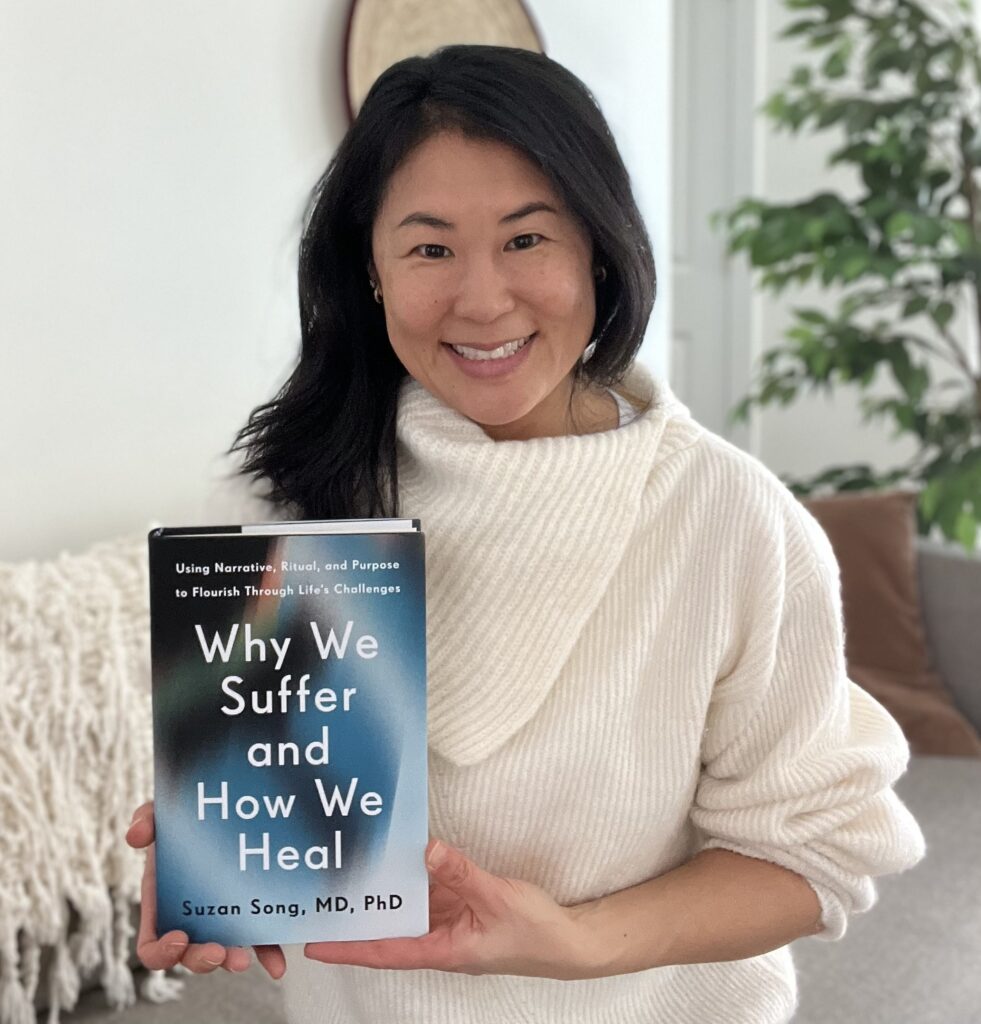
Doctor Suzan Song is a psychiatrist and humanitarian mental health expert. Doctor Suzan is the author of the book Why We Suffer and How We Heal & it is available now, wherever you get your books! Suzan is a Harvard and Stanford trained psychiatrist and humanitarian mental health expert & has spent 2 decades in this work. Suzan & her work has been featured on NPR, MSNBC & other media outlets. She has private practice in the Washington DC metro area and California and is a psychiatry professor at George Washington University.
Q: Welcome to Book Notions Suzan! Would you please give a brief description of Why We Suffer and How We Heal?
A: Why We Suffer and How We Heal explores how people stay grounded and find a sense of competence when life becomes destabilizing, whether through loss, illness, conflict, or uncertainty. Drawing on my work as a psychiatrist in humanitarian settings, the book looks at how cultures around the world respond to suffering.
Rather than trying to eliminate pain, it focuses on three practices that help people stay whole: the stories we tell about our lives (narrative), the small repeated actions that give difficult periods structure (ritual), and a sense that our efforts connect to something larger than ourselves (purpose). The book asks a simple question: when life doesn’t cooperate, what actually helps us stay steady?
Q: How long did you spend researching and writing Why We Suffer and How We Heal?
A: I’ve been thinking about this topic for two decades but started writing the book 3 years ago.
Q: Which parts of the book, if any were your favorites to jot down? I like the REPEAT acronym R is for Recognize the underlying problem. E is for Explore the Repetition. P is for Pause the Pattern. E is for Embrace. A is for Act with Intention. T is think Through the Maze. It’ll help many people ponder what the problems are, how we got there and how to heal and break the patterns and cycles for ourselves and our future children.
A: I’m so glad you found that helpful. Writing about the cases was probably my favorite part of the book. As I worked on those chapters, I often found myself thinking about those individuals and their lives, almost as if I were bringing them into the room with me while I wrote. It felt like a gift to reflect on what they had gone through and what we had learned together.
But more specifically, my favorite section ended up being the final chapter. In earlier drafts it was actually the opening chapter, because I feel strongly that the concept of “resilience” can sometimes be misused. At times it places the burden on individuals to endure systems or circumstances that should actually be questioned or changed. I wanted the book to acknowledge both realities: that people are capable of remarkable adaptation, but that suffering is not something we should simply ask people to tolerate indefinitely.
Q: I also like how you mentioned meditation being healthy for everyone at one point in the book since I pray the rosary daily and meditate on it. Would you say having faith in a higher power is also healthy for healing?
A: What the research consistently shows is that practices that create reflection, meaning, and a sense of connection can be very stabilizing. For many people, faith traditions provide that structure—through prayer, ritual, and a relationship with something larger than oneself. For others, similar benefits come through different practices like meditation, time in nature, community, or service.
What matters less is the specific belief system and more the function the practice serves: creating moments of pause, helping people organize their inner life, and reminding them that they aren’t facing suffering entirely alone.
Q: In your years as a psychiatrist & humanitarian mental health expert, what wisdom do you have for anyone wanting to pursue the same career as you have? What are the skills you think are the most important for anyone wanting to be an excellent psychiatrist?
A: That would be amazing if others were interested in this career–there aren’t many doing it. I think two qualities matter more than almost anything else: humility and boundaries.
Humility is essential because psychiatry, and humanitarian work especially, puts you in contact with lives and cultures very different from your own. You have to approach people with genuine curiosity and a willingness to learn from them, rather than assuming you already understand their experiences or what they need.
At the same time, strong boundaries are critical. Clinicians inevitably draw on their own humanity and life experiences to connect with patients, but the work cannot become a mirror of our own stories or unresolved issues. When that happens, it can blur judgment and shift the focus away from the person seeking help. Good psychiatrists know how to stay present and empathic while still maintaining enough professional distance to think clearly and act responsibly.
Q: Congratulations on being featured along with your work, on NPR & MSNBC & other media outlets! How does it feel knowing that you and your work have been featured in major media outlets?
A: Thank you. Initially it felt a bit exposing, as my training has always emphasized keeping my personal life fairly private. I’m not particularly drawn to visibility for its own sake. But the book has only been out for a week, and I’ve already heard from many people who say a passage resonated with them or that they shared an excerpt with a friend or family member. When I hear that, it starts to feel less about exposure and more about service, which is a role I’m much more comfortable with.
Q: Would you ever write a nonfiction book about your humanitarian work? I know I, along with many readers, would love to read a book more in depth about your humanitarian work. Are you currently writing your next book now and if it’s not too early, can you reveal any details?
A: The book I just released is nonfiction and much of it draws directly from my years working in humanitarian settings. Those experiences shaped how I think about suffering, resilience, and what actually helps people remain psychologically intact during periods of instability.
As for another book, it’s a little early to say what that might be. I’m paying close attention to what readers are responding to and what questions seem to stay with them after they finish the book. If there is a next one, it will likely grow out of those conversations and the areas people want to explore more deeply. Would love to hear ideas!
Q: Would you please provide your social media links so readers and I can follow and subscribe?
A: My website has lots of information: www.suzansong.com, including a newsletter one can sign up for, where I expand on some of these topics, as well as Three Friends of Winter Circles, to encourage people to gather with a friend or two quarterly to discuss various themes of the book. I’ll eventually start a Three Friends of Winter Salon for high performers who are managing instability.
Instagram and FB: @drsuzansong
Linkedin: suzan-song