Newsletters
Authors In The Media With Monica Comas
New Information about Upcoming Book Related News
Authors In The Media With Monica Comas
Sometime ago, I did a Q&A with author Monica Comas which you can read by clicking this link https://booknotions.com/qa-with-monica-comas/ . While we spoke about her books, we briefly did touch on her past career as a journalist and financial editor! Now Monica has returned and we will go more in depth in this edition of Authors In The Media!
Q: Welcome back to Book Notions Monica! Before becoming an author, what drew you into the world of finance & journalism?
A: Thank you so much for having me back to Book Notions! I love talking about my career before focusing on fiction because I think being a novelist really draws on the discipline you develop working as a journalist.
I was attracted to journalism for a simple reason: I wanted to have a job writing. I earned a master’s in journalism from New York University not because you need a master’s to be a journalist, but because I loved going to school and wanted to try living in New York City. While I was at NYU, I got an internship at Saveur magazine (I’d always loved magazines and food—and Saveur was the hot new foodie mag). They ended up hiring me, but what I didn’t realize at the time was that working at a magazine often didn’t involve writing.
So, I left this cool job with its cool office in SoHo and went to a community newspaper in South Jersey, where I was thrown into the nonstop hours of local journalism covering local government, school boards, planning boards, all manner of local news. And I learned a ton. After that job, I went to two community papers in New York City, then, anxious to earn more (NYC is expensive!), I got a job with SmartMoney.com where I specialized in writing about stocks, investment strategies, and the economy. It was great. Because SmartMoney was the personal finance magazine of The Wall Street Journal, some of my pieces got placed in the Journal. A lot of history happened while at SmartMoney.com: the dot com era, Enron and the ensuing market fallout, and, heartbreakingly, 9/11.
After a decade as a journalist, right around the time the industry was changing (focusing less on what was being written and more on eyeballs/ad dollars), I made the leap to financial editing at Citi. There, I edited investment strategy and economic pieces for their client-facing publications.
While at Citi and eager to get back to my first love, fiction, I started waking up early to work on a novel before heading off to my day job (like so many authors do). Eventually, I left Citi and freelanced for them and Goldman Sachs. And then, as I spent more time on my fiction writing, I stepped back from freelance financial editing until fiction (happily!) became my sole focus.
Q: Did you become a financial editor first and then a journalist or did you become a journalist first and then a financial editor?
A: I was a journalist first, and I’m glad that I was.
You learn so much as a journalist it’s literally a training ground for every subject. Often, you’re going into a story without knowing much about it and so you must dig in, research and report until you’re educated on a topic or an event. But more than that, working as a journalist gives you the understanding of how a story should be structured, what is needed (and what’s not), and what draws a reader into a piece. I think all of this is necessary if you’re going to do any type of editing. Being a journalist allows you to develop the skills that help you edit others’ work, as well as your own.
Q: Did you go to college for both financial editing & journalism? Or for journalism did you apply for a job right after graduating high school? I know for every author who was or is still a journalist, they all have unique journeys as to how they got there, which is fascinating!
A: It’s so true, everyone gets into writing differently!
For me, I graduated from The Ohio State University with an English degree, and to be honest, didn’t have any idea how to parlay that into a writing career. I wasn’t involved in the school paper (a mistake, I realized too late) and didn’t know the first thing about journalism. But I loved school. I loved learning. So, I applied to graduate school to prepare me for a career in journalism. Could I have gotten a beginning job at a newspaper, learned on the job and worked my way up? Absolutely. But like I said, I loved school and had a romantic notion about moving to NYC. Was I putting off getting a real adult job? Maybe just a little.
I’m actually glad that I went the grad school route. I met terrific people, and it gave me the grounding for a career I loved. While at NYU, for various articles I wrote (in-class pieces or for the student paper), I interviewed Francis Ford Coppola (I made the most of my student press pass!), stood on scaffolding that wrapped around the outside of the Chrysler Building’s shiny crown (the only place I’ve ever been in the city where it was pin-drop quiet!), and went on a ride along with the NYPD. The city was a terrific place to run around, interview people, and learn the craft.
Q: What wisdom have you learned as both a journalist and financial editor, do you have for anyone wanting to pursue both careers?
A: I think the one piece of wisdom that I return to time and again is discipline. There’s no mailing it in when you’re a journalist or when you’re editing someone else’s work. You need to show up. You need to sit and do the work. Make the calls. Research the story. Edit the piece. You need to have discipline about your craft.
I feel like when you have discipline and respect for what you’re doing, you regard yourself with a seriousness that serves you. You are a journalist. You are an editor. This is a hallowed profession that is worthy of seriousness and discipline. Take it seriously and take yourself seriously.
Should you ever want to springboard from journalist/editor and become an author, the discipline that you practiced will reward you every day. You will already know how to show up. It will be ingrained within you that you *need* to show up to the page, that this is your job. You will take yourself seriously. I feel this is so important, particularly with creative endeavors.
Q: This is my favorite question to ask anyone who was/still is a journalist! Would you like to reveal who you’ve interviewed during your journalism career? What were those experiences like?
A: One interview I will always remember was with Nora Ephron. I was fortunate enough to interview her with a colleague right before I made the jump to SmartMoney.com. This was right after You’ve Got Mail came out, and she graciously invited us to her apartment on the Upper West Side. It was such an honor to meet and interview this iconic writer and director.
Aside from Nora Ephron, the most interesting interviews I’ve done were with everyday people, folks endeavoring to make their communities better, safer, and more inclusive.
I’ve interviewed famous, boastful, empty people who were so boring to me. Utterly unworthy of being elevated (to be clear, I’m not speaking of the dazzling Ms. Ephron here!). But the people I met who were living quietly and purposefully, the ones who were trying to improve their communities, these are the people who I found compelling, engaging and most deserving of being written about.
I’m talking about the community activists who battled a big developer from overbuilding their neighborhood. The woman who finally was approved to adopt the child she’d always dreamed of. Local elected officials who were doing everything they could to improve the municipalities where they lived. It’s easy to be dazzled by a big name, but to me, the most interesting people were the ones I was riding the subway next to or shopping at the grocery store with.
What I learned was that everyone has a special story. Finding those glittering threads within people and sharing their stories…this was a profoundly special experience.
Q: Is it a fair assumption that your journalism career was a tremendous help when it comes to writing & editing your books? Would you ever return to your journalism career or have you moved on?
A: Yes, journalism was an incredible help to me as an author! I spoke of the discipline that you cultivate as a journalist—you can’t show up to work and tell your editor that you don’t feel like writing, that the muse isn’t moving you. You must show up every day and work. And that’s a mindset that has served me over and over again in writing fiction. The words might not always come easily, and they might not always be usable, but I’m not the least bit precious about the process. Writing fiction is a job like journalism is a job. Both require me to show up no matter what.
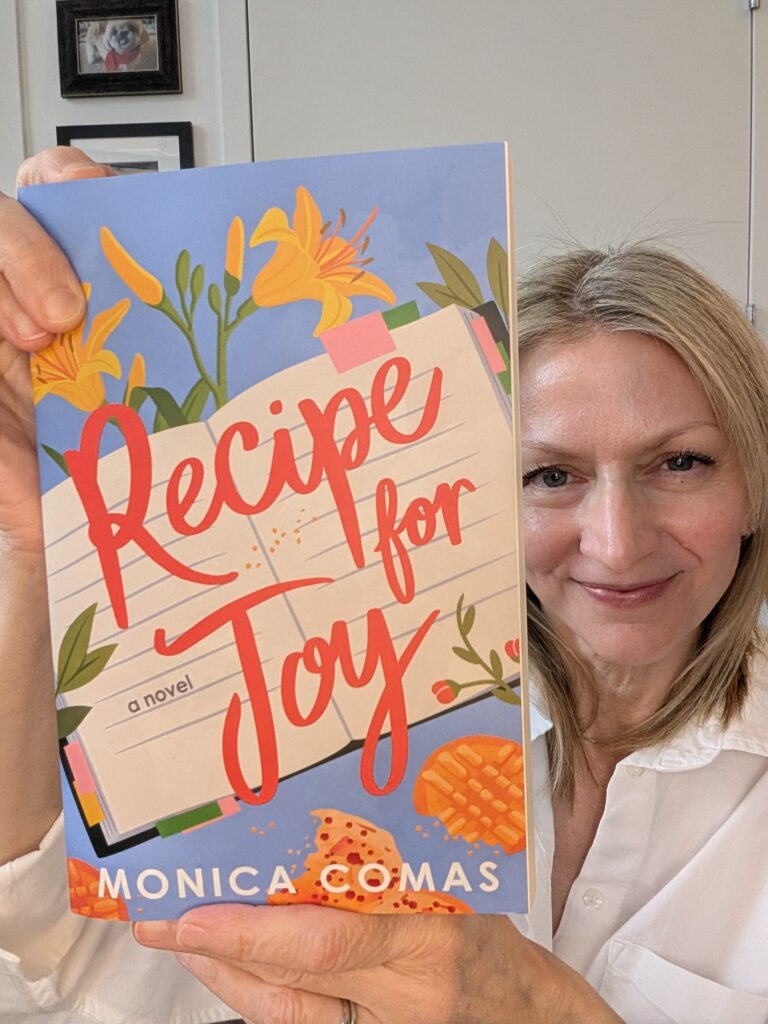
As for whether I’d ever return to my previous career, I really have no desire to do the journalism I used to do. However, I absolutely love writing essays and columns, so I’d jump at the chance to do more of that. With Recipe for Joy, I was fortunate enough to have a bunch of essays placed, and that was so fun and fulfilling. So, yes to more of that!