Newsletters
Q&A With David Hirshberg
New Information about Upcoming Book Related News
Q&A With David Hirshberg
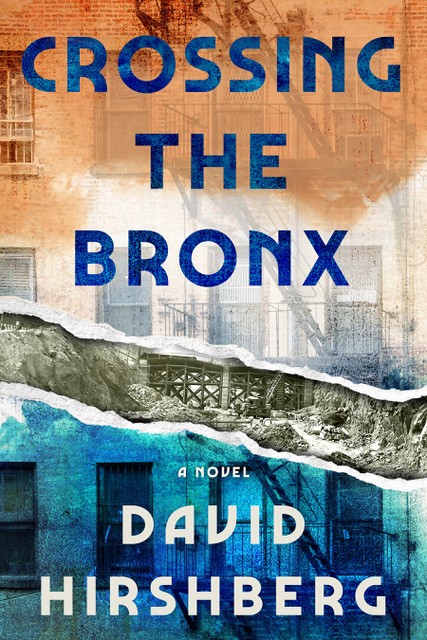
Rachel Tarlow Gul has connected me with author David Hirshberg for this Q&A. David is the author of My Mother’s Son, Jacobo’s Rainbow, & his upcoming release coming to bookstores on June 2nd, Crossing The Bronx!
Q: Welcome to Book Notions David! Would you please give a brief description of your novels beginning with Crossing The Bronx?
A: Thank you, Bianca, for the opportunity to speak about my novels. It’s greatly appreciated.
Crossing the Bronx is an historical literary novel set primarily in the 1950s in The Bronx. It’s a modern retelling of the Jacob and Esau story from Genesis. The narrative that propels the story forward concerns the destruction of a neighborhood—the construction of the Cross Bronx Expressway—in the guise of progress. Brothers Jay and Eric are estranged and find themselves on opposite sides of a bitter struggle that pits those in power against the defenseless people of a local community.
My Mother’s Son is an historical literary novel written as the memoir of a radio raconteur that uses the inconceivable events of his family’s life and the world in which he lived—in Boston in 1952 when an Irish Catholic upstart fought a grueling race for the senate against a Protestant Brahmin—as a foil to deal with major issues that affect Americans today: politics, disease, war, immigration and business.
Jacobo’s Rainbow is an historical literary novel set primarily in the 1960s during the convulsive period of the student protest movements and the Vietnam War. It focuses on the issue of being an outsider—the ‘other’—an altogether common circumstance that resonates with readers in today’s America; it speaks to universal truths that affect us all.
Q: Where do ideas for all of your novels come from & how long does it take you to write them?
A: I ground my novels within the context of actual events, which enables those who lived through the 1950s and 60s to get a different perspective on what they might have remembered. And for those too young to have had eyewitness observations, it provides insight into a history they might have heard about or studied that allows them to get a feel for alternative viewpoints.
With regard to how long it takes to write novels, what I can say is that over time, it gets easier. My Mother’s Son took nine drafts over a period of three years before I felt it was ready for publication. Jacobo’s Rainbow took two years and three drafts. Crossing the Bronx took less than two years and involved two drafts.
The interesting thing is that when I compare the original draft of My Mother’s Son with the one that was published, only 2,000 words made it to the final version. And in the case of Jacobo’s Rainbow, after the initial draft was completed, I deleted the entire first half of the book and began it anew with the second half becoming the opening of the novel. By the time I got around to Crossing the Bronx, I only had to make a few edits to get it in shape to send it out for pre-pub reviews.
Q: Which scenes did you enjoy creating the most? I do enjoy the setting of 1950s New York!
A: In all the years of giving interviews, responding to inquiries, speaking on podcasts or in front of live audiences, I’ve never been asked this question, and it’s such a good one. In all of my novels, the greatest “kick” I got was from pretending that I was actually in the scene—not as an observer—but as a participant, one of the characters, which allowed me to absorb the then-current vocabulary and diction, wear the au courant clothes, act in the way that a person of that era would have behaved, and think like someone who was ensconced in a particular time that was framed by its own peculiar cultural, economic, and political events.
Now, as this relates to Crossing the Bronx, the scenes I enjoyed the most had to do with actual locations: in Tremont Park where unscrupulous deals were sealed late at night; in a bar overlooking Coogan’s Bluff, where many of the characters tangled verbally; on Arthur Avenue, the setting for a social club, where business meant business; inside a record store where kids played music in closed listening booths; in the office of a movie theater, where a hit occurred; in the county courthouse when lives were altered; in a jail in upstate New York, where the protagonist was sent; and in the office of the protagonist’s court-appointed shrink.
Q: What are messages and emotions you hope readers walk away with after they finish reading your work?
A: All of my novels can be read on three levels: (1) The story of what it was like to have lived through the Depression and World War II era, and into the one that emerged after 1945—a society that was being altered almost unknowingly into something that would turn out to be significantly different in terms of social activism and ethnic politics; (2) A metaphor for what is going on in the country today, in terms of the conflicts between ‘ordinary people’ and powerful politicians and business interests; and (3) How families emerge from dysfunction to find their way despite implacable obstacles in their paths.
My novels have been purposefully set in earlier times to provide some distance from the current ‘talking heads’ climate that instantly categorizes and analyzes events from a narrow, partisan perspective…even as they serve as metaphors for what is going on today.
With regard to Crossing the Bronx, it’s written as if it were ripped out of a series of newspaper articles from the 1950s and early 1960s (the now defunct New York Mirror plays a prominent role).
The main story arc is but a foil to deal with major issues that affect many Americans today: politicians and businesses using ruthless tactics to gain financial returns and power; the sense of hopelessness in fighting ‘city hall’; the clash of ethnic groups jockeying for positions in the community; the role that strong women are playing outside of the home; and the incessant levels of crime that never seem to abate.
Q: Does Hollywood have the rights to your work? Who would be your dream cast to play the characters within your novels?
A: Funny you should ask because I have written screenplays for both Crossing the Bronx and Jacobo’s Rainbow. A screenplay is a completely different can of worms compared to a novel. Very challenging, but I am highly motivated. So, how would I cast Crossing the Bronx? I’d have to give a brief description of some of the main characters, and then readers can visualize who they think would work in this role and then compare that person to those who I selected.
Jay deVenezia: Jay is shaped by his abusive father and bullying brother. He begins to understand the impact of his lies, manipulations, and thievery. His experience in the army, his relationship with Francesca, and his involvement with a rabbi who is his mother’s close friend, contribute to his growing maturity that manifests itself in his co-leadership of the group that attempts to stop the building of the Cross Bronx Expressway through 176th Street. In this effort, he lines up against his father, his brother, the mobbed-up construction company, and the major players in the building of New York post-World War II. [Jacob Elordi]
Francesca Casterella: A street-smart young woman who forms a deep relationship with Jay is quick-witted, sharp with the tongue, and perceptive. She can separate the wheat from the chaff as well as anyone could imagine. [Elle Fanning]
Eric deVenezia: Eric is a bully who seeks the approval of his father. He is a thug until he realizes that he, too, is going to be thrown under the bus by the mob. [Alex Wolff]
Isaac (Ike) deVenezia: Ike is a complex character who tries to navigate in three worlds: the police department dominated by the Irish, the construction company run by Italians, and his Jewish home. He succeeds in the first two but fails abysmally in his home life. [Liev Schreiber or Sasha Baron Cohen or Jeff Goldblum]
Alberto Giaquinto: Alberto’s grip on major construction projects in The Bronx is tight, and he is prepared to do whatever it takes to double-deal on the new expressway project. [John Turturro]
Dr. Leah Silverman: Jay’s court-appointed therapist, she offers sage advice to Jay, who grows emotionally after his time with her. [Sarah Silverman]
Daniela Lagana: Also known as Nonna Ebrea, Daniela is Francesca’s maternal grandmother, who appears to be a fabulist, but ultimately is shown to be crazy like a fox. [Edie Falco]
Q: Can you reveal the details of the next novel you are working on or is it too early to discuss right now?
A: The truth is that I have pivoted to screenplays, having completed my novels that comprise the Mid-Century Trilogy of the American experience after World War II.
Q: Would you please provide social media links so the readers of the blog and I can follow your work?
https://www.facebook.com/david.hirshberg.754
https://www.goodreads.com/author/show/17325071.David_Hirshberg