Newsletters
Q&A With Judy Batalion
New Information about Upcoming Book Related News
Q&A With Judy Batalion
New York Times Bestselling Author, Judy
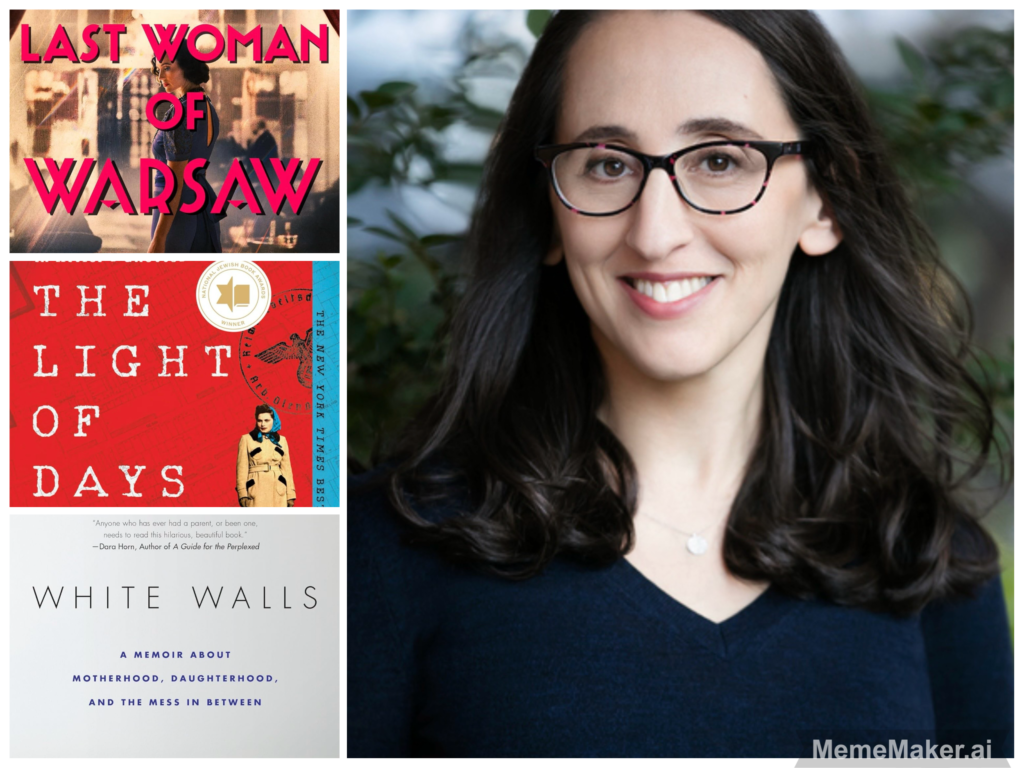
Batalion is my next guest for this Q&A for Book Notions. Judy is the author
of the nonfiction book The Light of Days, her memoir White Walls &
her debut historical fiction novel, The Last Woman of Warsaw is
available today on April 7th wherever you get your books! Judy
Batalion has also written essays and articles for The New York Times,
the Washington Post, Vogue, the Forward, Salon,
the Jerusalem Post and many other publications.
Q: Judy, would you like to give a
brief description of each of your books starting off with The Last Woman of
Warsaw?
A: The Last Woman of Warsaw is the tale
of unlikely and powerful friendship between two very different young
Jewish women – a fashion photographer and a political activist – and it’s set
in dazzling, sophisticated and fashionable Warsaw in 1938. We don’t really
think of pre-war Warsaw as being a cultural hub, but it was the locus of
theater, vaudeville, comedy, fashion – there were 130 Jewish newspapers
published there at the time. I wanted to explore women’s lives in this exciting
world that was also on the brink of war.
The Light of Days
is the true story of young Jewish women and teenage girls who resisted the
Nazis from the ghettos in Poland. They ran underground schools, secret
libraries and soup kitchens, and they sabotaged Nazi trains, worked as weapons
couriers, and flung Molotov cocktails during ghetto uprisings.
White Walls: A Memoir About
Motherhood, Daughterhood and the Mess in Between,
follows my relationship with my mother, who suffered from compulsive hoarding
disorder, and shares how I not only came to terms with it but learned from it,
as I became a mother myself.
Q: How long did it take you to
research The Light of Days & The Last Woman of Warsaw? What
was the transition like going from writing nonfiction to then writing
historical fiction and what is your advice for anyone wanting to write
both?
A: I began working on The Light of Days in
2007 when I happened to come across an extraordinary Yiddish book from 1946
about Jewish women who resisted the Nazis. I’m still researching and writing
about this subject! So – egads – it’s been nearly 20 years. In non-fiction, the
challenge was to make a cohesive history out of 100s of documents, and then to
fact-check and footnote every single detail. With fiction, the challenge was to
come up with a suspenseful story while also considering the ethics: what elements
of history can be altered?
My advice about writing any of kind of history
is to actually write. It is easy, and tempting to get stuck in research.
But research never ends. There is always another archive, another book, another
person to interview. At some point, you need to stop, say “I’ll read that later
if I can,” and just start to pull together your thoughts.
Q: While you were writing your
memoir White Walls, did it feel therapeutic writing your story down and
were there memories that were tough to write down?
A: I always write to make sense of something.
I needed to make sense of my complicated relationship with my mother as a I
became a mother myself. I can’t say I figured it all out, but I figured out a
few things, so, yes. Understanding myself feels liberating and is
cathartic.
Q: What are lessons you hope
readers learn and remember after they finish reading your books?
A: I don’t initiate books to teach lessons –
I’m usually fueled by a desire to explore an area that just isn’t talked about
(and should be!). But over the years of writing and then speaking to readers, I
suppose certain things have become important to me. In The Last Woman of
Warsaw, I want readers to understand that our world is very similar to the
world of Warsaw in the 1930s; what happened to their sophisticated and vibrant
culture can so easily happen to ours. In The Light of Days I want
readers to know that Jewish women were not passive during the Nazi’s genocidal
assault, but were active resistors who risked their lives time and time again
to fight for justice, liberty and dignity.
Q: Will your next book be another
historical fiction, historical nonfiction or a memoir? Or are you juggling
multiple projects?
A: My next book is actually a totally
different beast – it’s a health book! I’m co-writing it with NBC’s Chloe Melas
– we both have ulcerative colitis. This book addresses the day-to-day realities
of living with various bowel diseases. And it’s funny. (I hope.)
But I also have several novel ideas on the go…
we’ll see what sticks. More soon!
Q: What’s it like writing essays
& articles The New York Times, the Washington Post, Vogue,
the Forward, Salon, the Jerusalem Post and many other
publications? What’s your advice for anyone wanting to submit their work to
these publications?
A: I can’t stress enough how important it is
to read the publications and the particular columns or sections to which
you’d like to submit your work. Do they run personal essays, and/or opinion
pieces and/or research-based pieces? Do they run first-person writing? How long
are their pieces? If you want to sell work to an existing publication you need
to understand and write to their framework.
Q: Would you please give links to
your social media accounts so the readers of the blog and I can follow
you?
A: I’m @judybatlion on IG and
JudyBatalionAuthor on FB. Please follow me!