Newsletters
Q&A With Deborah Lee Prescott
New Information about Upcoming Book Related News
Q&A With Deborah Lee Prescott
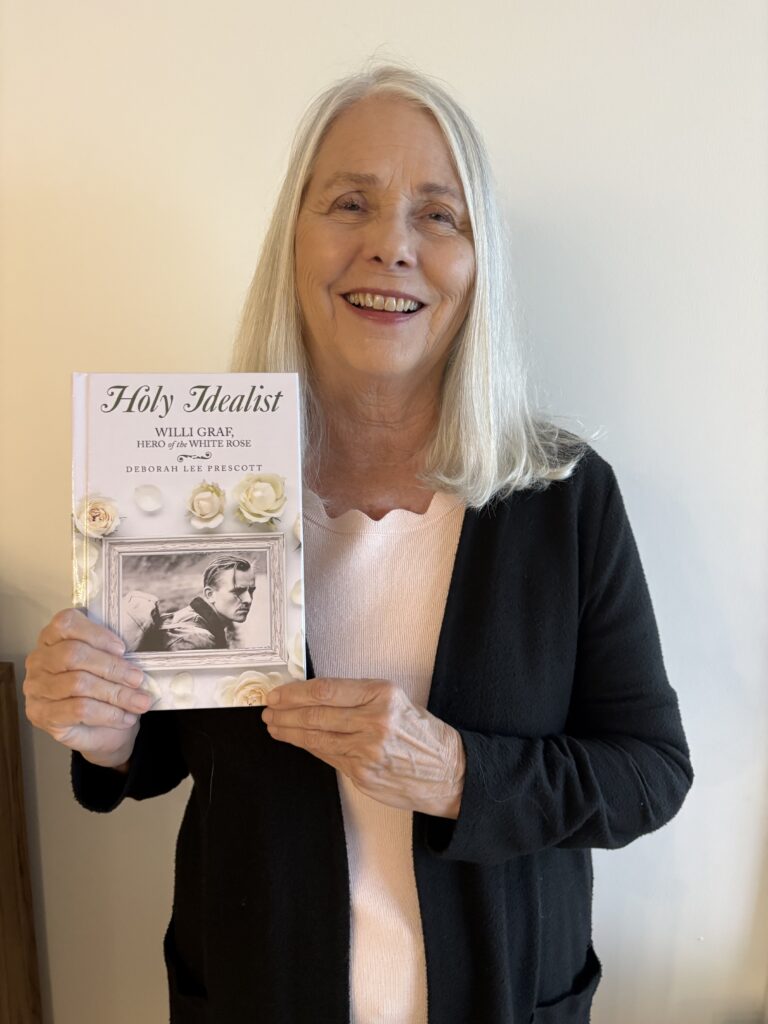
Deborah Lee Prescott is the author of her creative nonfiction debut Holy Idealist, which is available now wherever you get your books! Deborah also has a historical fiction book titled Taken Away & several children’s books. I’m so delighted that Evie Lue connected me with Deborah for this Q&A.
Q: Deborah, welcome to Book Notions! Would you please give a brief description of each of your books beginning with Holy Idealist?
A: Thank you for inviting me to visit with you and your readers! I am honored to be with you. Holy Idealist is my seventh book, so I’ll start with that and then work backwards.
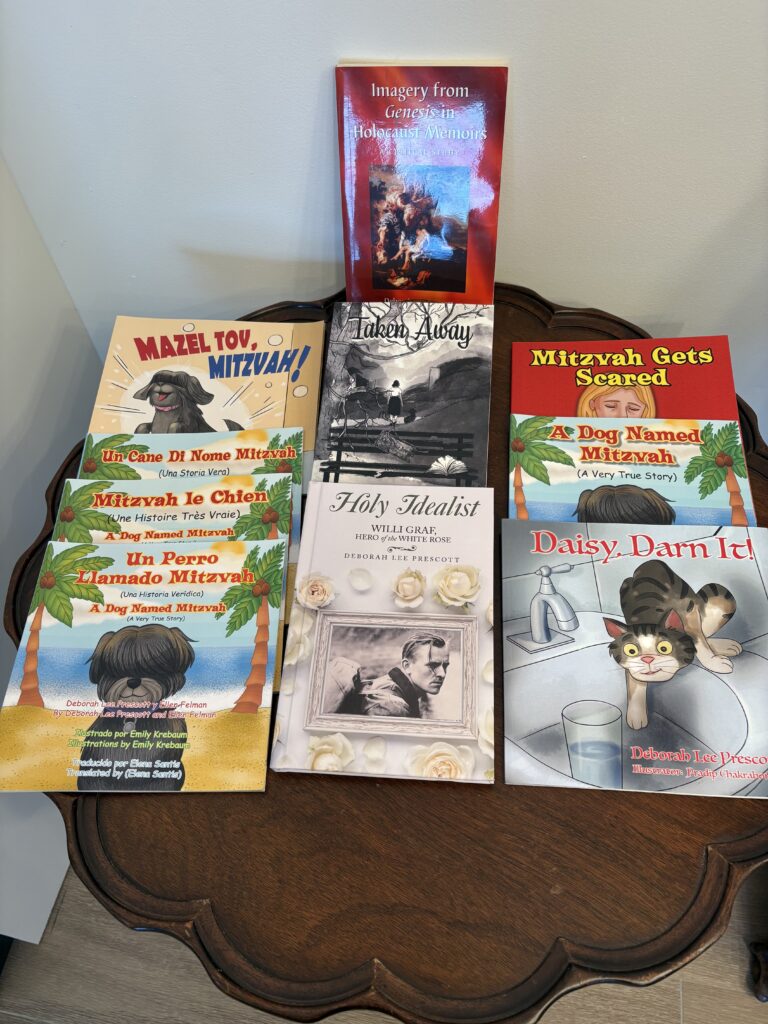
Holy Idealist is the biography of a WW2 hero, Willi Graf, who, along with a few other college students, risked everything to bring down Hitler and end the war.
Taken Away is a coming-of-age novel based on a play I co-wrote with a theater colleague. Growing up in pre-war Nazi Germany, Elfie is increasingly disillusioned with the hate-filled messages that surround her, even though her friends willingly embrace what Hitler Youth teaches.
Daisy, Darn It! is a children’s picture book in which my rascally cat Daisy narrates her morning-to-night comic misadventures.
Mazel Tov, Mitzvah! is a children’s picture book in which my blind dog Mitzvah celebrates creating a new family through adoption.
Mitzvah Gets Scared has Mitzvah explaining that noises frighten her because she is blind. However, she has learned that with the help of people who love her, everything will be all right.
A Dog Named Mitzvah introduces children to a shaggy mutt who had been thrown away, but she found a loving home with me. An illness caused her to become blind. With joy and courage, Mitzvah learns to cope with this challenge. The book has three bilingual versions: French / English, Italian / English, and Spanish / English.
Imagery from Genesis in Holocaust Memoirs was my first published book. In this scholarly literary analysis of Shoah autobiographies, I demonstrate the often-surprising ways in which survivors turn to the Biblical book of Genesis to contextualize their experiences.
Q: How long did it take you to research and write Holy Idealist? Did you go down a research rabbit hole at any point?
A: Holy Idealist was six years in the making. I began the first draft during the shut-down pandemic days and worked on it steadily until it was published in early 2026. My life-long interest in the Holocaust and the dramatic events of World War II led me to the White Rose, a nonviolent resistance group comprised of a few university students and one professor. The White Rose is justly celebrated in Europe but is less well known in the States. Even in Europe, Willi Graf is the least-known member of the group, despite his daring actions. I wanted to tell his story, and I felt that young readers (Middle Grade and up) might find his beliefs and adventures inspiring.
Although I wrote and revised throughout those six years, often changing the structure and point of view, from the start I was committed to telling the story in the genre of creative nonfiction. “Nonfiction” because the account of Graf’s life is accurate; “creative” as I imagine various conversations and reactions Graf and his friends might have had, based on my knowledge of them.
Most of my professional life was as a professor of literature, and my scholarship focused on autobiographies written by Jewish Holocaust survivors. My academic writing blended literary analysis, historical inquiry, and theological reflections. Fair to say that I thoroughly enjoy the fun detective work of research! I am happy to chase those elusive rabbits because, for me, delving into research is invigorating.
Q: What are lessons and reminders that you hope readers remember and learn after they read Holy Idealist?
A: Willi Graf lived during one of the most dramatically dark times in world history. As a young man, he recognized the horror that had engulfed Europe. Remarkably, he accepted responsibility for it. He wrote, “It’s not that something must be done; it’s that I must do something.” I hope that regardless of readers’ political or religious stances, they will be inspired by Graf’s commitment to live up to his ideals, which were based in his religious faith. Currently, the Catholic Church is considering Willi Graf’s cause for sainthood.
Graf lived in an era in which the government was increasingly dictatorial and violent towards people they disliked. Hating groups perceived as “the other” was an essential part of the Nazi ethos; consequently, such attitudes were taught to young people. Graf saw the situation clearly as he stood virtually alone amidst his peers in his rejection of the Nazis. Graf’s ability to perceive and resist evil contains within it a message for today. Contemporary trends of demonizing the “other” and inflicting violence upon innocent people have unsettling parallels with Nazi Germany.
Q: Are you currently writing your next book? Is it nonfiction, historical fiction, or a children’s book?
A: I am not yet working on my next book, although I do write regularly as a volunteer for a local animal shelter. Each week I am assigned a cute dog or cat and I invent a story, told from the animal’s perspective, which I post on Facebook. Our goal is for pets to find their forever home through the wonder of social media. Currently, I am concentrating on various activities to promote Holy Idealist. But as I think ahead about my next book project, I am considering the following options.
*I state in Holy Idealist that I envision the book to be the first in a series about brave Christians who resisted the Nazis. Would that there had been more of them. Nonetheless, there are many wonderful people whose stories I want to tell. I am in the process of deciding which person I will focus my attention upon.
*I am flirting with the idea of turning Willi Graf’s story into a screenplay for a movie or a mini-series. His short life was filled with drama, action, risk, faith, and heroism. I think it would be perfect for the screen, be it small or big.
*I am considering writing a children’s picture book about Buster, a scruffy dog that I fostered for several months. Resilient Buster is a small one-eyed mutt who has endured many hardships. At each obstacle, Buster’s zest for life enables him to overcome his challenges.
Time will tell which writing idea enables my next book.
Thank you, Bianca, and the readers of Book Notions!